

How landlords can make their properties more eco-friendly! (Book your Energy Performance Certificate now)
Energy Performance Certificate (EPC) – don’t groan – has been around now for about 13 years and have become an integral part of letting your property. As a landlord, you are now required to complete an EPC on your property to ensure it meets the required standards for rental properties.
Energy Performance Certificates are valid for 10 years so it is important to ensure your EPC is still in date. If you have completed any significant changes to the property such as installing new heating it is also worth having a new Energy Performance Certificate completed to review the changes and ensure you are still within regulations.
What to do if your property’s Energy Performance Certificate is below MEES standards.
So, what happens if you have a property that is a band F or G, does that mean it cannot be rented?!
Firstly, you need to look at the property and get some good advice. In most cases, there will be plenty of opportunities to improve the property’s energy efficiency and hence its EPC rating. However, the choice of what type of improvements to do and which ones will give you the best result on your EPC is a more complex question. Where possible you will need to make improvements to the property and the best person who can give you advice that is cost-effective and gives the best results is your Energy Assessor, speak to them first!!
At the end of the day, your Energy Assessor will do this day in day out and they will be able to advise you on the easiest and most cost-effective ways to improve your EPC rating. We have our own in-house EPC assessors and are always happy to provide advice and support.
What about changing light bulbs to fix the Energy Performance Certificate?
Please don’t assume that changing all the light bulbs to low energy bulbs is going to make a massive difference – it doesn’t. Changing your light bulbs will make a tiny improvement to the property, particularly if you are dealing with a property in rating F or G. You have bigger issues than light bulbs at that level.
What makes the most difference is insulation and heating! The amount of benefit these will give will depend on the specific property in question. However, before you go rushing off to call the plumber or insulation companies, make sure you do your research there is a wide range of options for both heating and insulation. You don’t want to make costly mistakes with either of these and getting independent and expert advice will likely save you thousands.
Night Storage Heaters – bring them back!!
There was a trend a few years ago (before MEES) to remove night storage heaters and install fancy electric panel heaters – salesmen will be cringing at me calling them a ‘panel heater’ but that is what they are 1kw in 1kw out!
The effect of this was devastating on Energy Performance Certificate ratings. Although these new heaters were efficient, the old night storage heaters used cheap rate electricity to heat up overnight, householder (tenant or otherwise) could have more efficient heating bills as they had a dual-rate meter and could take advantage of the cheap overnight rate. Taking these out also took away the dual-rate meter and this along with the loss of the night storage heaters gave a dramatic drop to the EPC and suddenly took properties below the required Band E.
The benefits of a good Energy Performance Certificate rating
When tenants are looking at properties there are clearly a few key factors in their choices such as location, number of bedrooms and so on. But once tenants have narrowed down their choices to a few properties they start to look more closely at the practicalities of each option. This is where a good EPC rating can be a real advantage. At the end of the day, an experienced tenant will know a better EPC means cheaper utility bills and better living space in terms of comfort.
Not to mention that a more energy-efficient property is likely to suffer from less of the common issues such as condensation, mould, and heating issues. Saving you money in repairs in the long run.
 Grants for EPC improvements
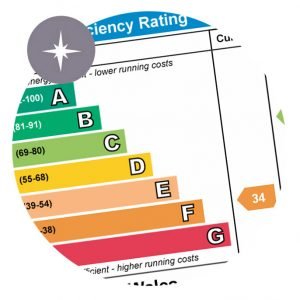 Grants for EPC improvements
There are several schemes available for some improvements, Green Homes Schemes, Energy Companies Obligation, ECO-Flex to name a few. These schemes can help to improve your property at little or no cost, but these schemes are an ever-moving beast, if we created a list of current ones here it would be out of date with a few weeks if not a few days. The best thing to do to access these schemes is to contact your energy supplier or local council to see what funding they have available. Inevitably you will need to use companies approved by the schemes so your usual local plumber may not be able to help.
What if I can’t make the EPC improvements?
If improvements are prohibitively expensive or cannot be completed if your property is in a conservation area or listed, then a Landlord may be able to apply to the Exemption Register. Further details can be found on the Gov.uk website but we are always happy to advise.
As a footnote Listed properties are not exempt from having EPCs, this is a common misconception that many newbie landlords run into when choosing to let a property that is listed or within a conversation zone. Listed properties must have an EPC just like any other property, but the difference is they can be exempt from carrying out improvements that can affect the aesthetics of the building.